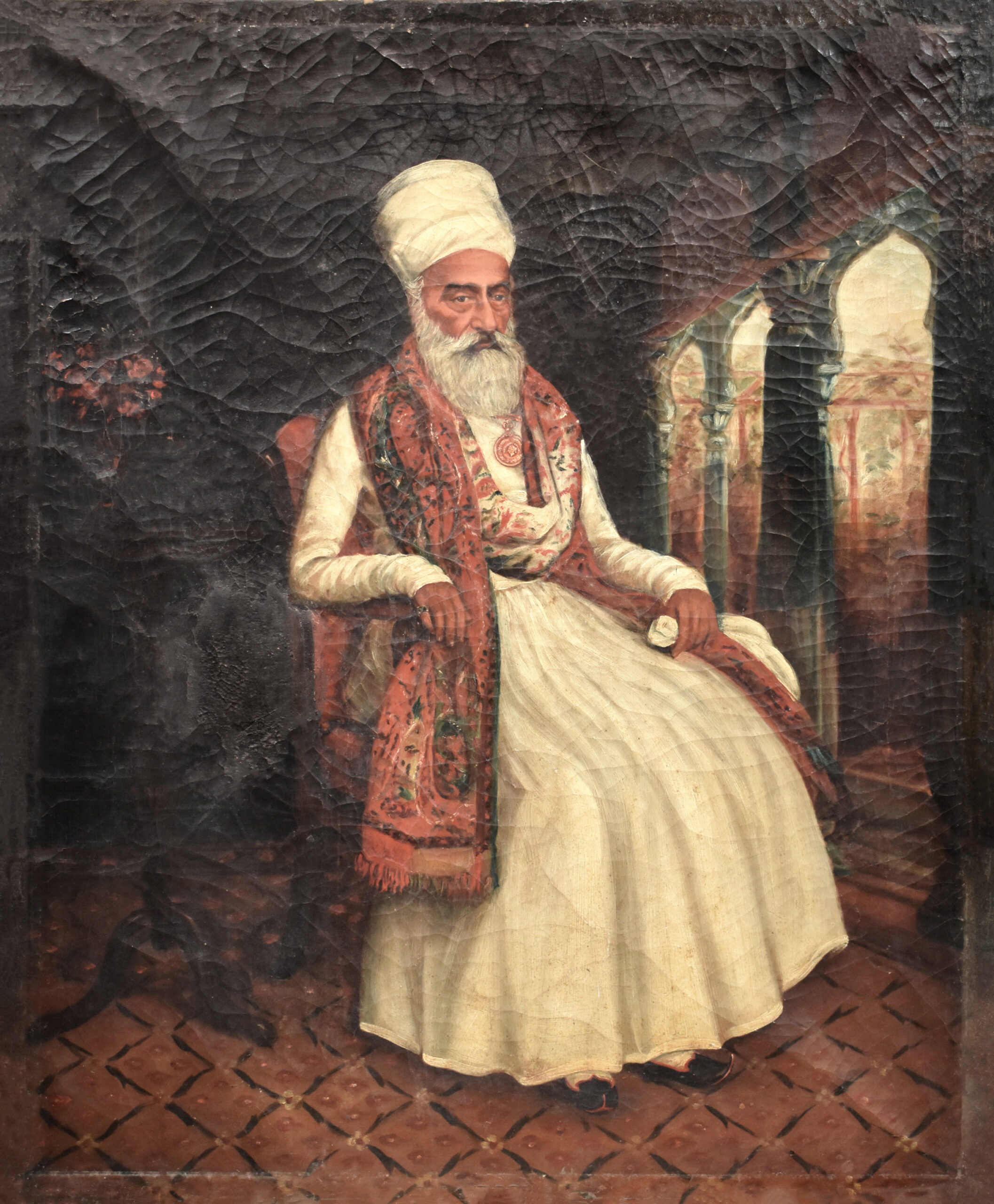
Khan Bahadur Pestonjee Sorabjee (1790 – 1861)
Mail contractor and Philanthropist from Pune
Artist Unknown (Chinese)
circa 1860, Oil on canvas
33 x 27 in. (83.8 x 68.6 cm.)
Khan Bahadur Padumjee Pestonjee was a distinguished member of the Parsi community in 19th-century Pune. His father, Pestonjee Sorabjee, had migrated from Surat to Bombay (1801) and later settled in Pune (1814). Both father and son played a notable role during the Indian Mutiny of 1857–58, providing valuable services to the British administration. In recognition of his loyalty and contributions, Pestonjee was awarded the title of “Khan Bahadur” in 1860-a rare honor for a civilian Indian of that period. The medal visible on his chest, in the portrait, is a testimony of this distinction.
The portrait was created by a mid-19th century Chinese artist, popularly known as Cantonese painters. These artists, trained in a hybrid Indo-Chinese academic style, had migrated from Canton (Guangzhou) to burgeoning port cities like Bombay and Calcutta. Many Parsis, with their growing wealth and social standing, became patrons of these artists. They commissioned portraits that blended European techniques with subtle Eastern aesthetics. These painters were particularly appreciated for their skill in rendering textures, facial likenesses, and opulent settings. All of this appealed to Parsi sensibilities and their desire to record lineage and prestige on canvas.